Can you hear where the sentence should stop?
What's in this lesson: short explanations, quick sorting tasks, guided fixes, a summary, and a 5-question assessment.
Why this matters: comma splices and run-ons make writing harder to follow. Fixing them helps your ideas sound confident and clear.
Read this sentence aloud: The bell rang, the students kept talking. It sounds like two complete thoughts squeezed together. Click the error type you think best describes it, then read the feedback.
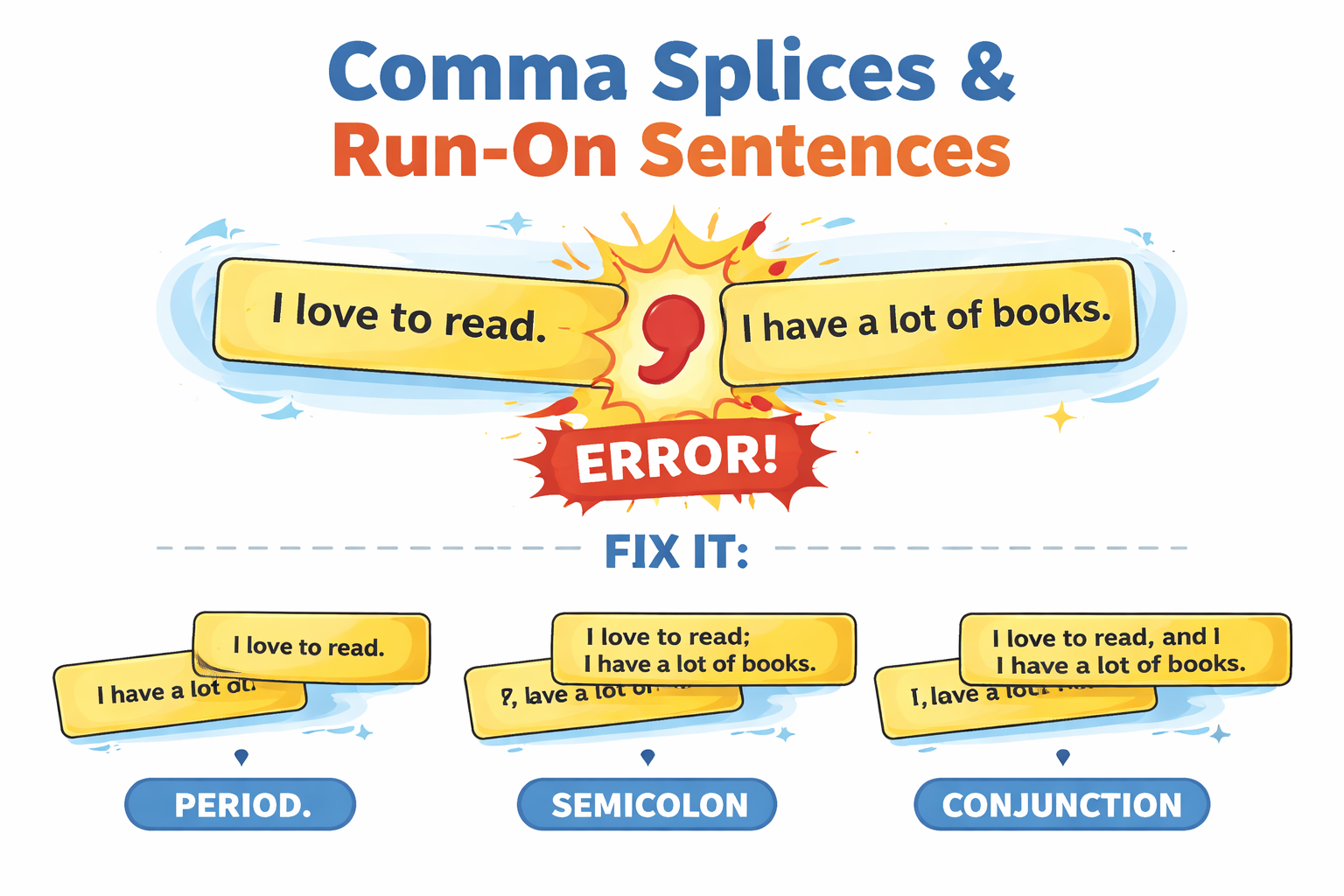
What is a comma splice?
A comma splice happens when a writer joins two independent clauses with only a comma. Each clause could stand alone as a full sentence, so a comma by itself is too weak.
Maria finished the lab, she forgot to submit it.
Both parts are complete sentences. The comma alone cannot correctly connect them.
Maria finished the lab, but she forgot to submit it.
See the weak join
Maria finished the lab.
,
Too weak to hold two full sentences together
She forgot to submit it.
What is a run-on sentence?
A run-on sentence, also called a fused sentence, happens when two independent clauses run together with no correct punctuation or conjunction between them.
| Error type | Example | Problem |
|---|---|---|
| Comma splice | It started to rain, we stayed outside. | Only a comma joins two complete thoughts. |
| Run-on | It started to rain we stayed outside. | No punctuation or joining word separates the clauses. |
Both errors join full sentences incorrectly. The difference is whether there is an incorrect comma or no boundary at all.
Tap to reveal the clue
Which clue helps you detect the error fastest?
KC 1: Name the error
Sentence: We wanted to leave early, the movie had not ended.
Four reliable ways to fix the error
Most comma splices and run-ons can be fixed in four standard ways. Click each method to see what it does.
Repair map
Two complete thoughts are stuck together.
Do you want a full stop, a joined idea, or a smoother rewrite?
Pick a period, conjunction, semicolon, or revised structure.
Choose the best repair
Sentence: The class was noisy, the teacher paused. Click the repair that uses correct punctuation and keeps the meaning clear.
Quick writer tip
If you hear a full stop in your voice, your punctuation should probably show that stop too. Reading aloud often reveals sentence boundary problems.
Can the first half stand alone? Can the second half stand alone? If yes, you need a stronger connection than a comma alone.
Say the sentence in two beats:
The class was noisy | the teacher paused
Hearing two beats helps you notice two full ideas that need a correct join.
Sort the sentences by error type
Click a sentence, then click the bucket where it belongs. Each move gives instant feedback.
Comma splice
Run-on sentence
Correct sentence
Selected sentence
Choose a sentence first.
Pattern reminder
- Comma splice: two independent clauses joined by only a comma
- Run-on: two independent clauses with no proper break
- Correct: punctuation or conjunction clearly joins the ideas
Comma splice = clause, clause
Run-on = clause clause
Correct = clause, so clause or clause; clause
KC 2: Best fix
Which revision correctly fixes the sentence?
Jordan studied all night, he still felt nervous.
Scan for sentence boundaries
When editing, do not just look for commas. Look for complete thoughts. If you see two subject-verb pairs next to each other, test whether they need a period, conjunction, semicolon, or revision.
The speaker finished her point the audience began clapping.
Could both parts stand alone? Yes. There is no correct boundary, so this is a run-on sentence.
The speaker finished her point, and the audience began clapping.
How would you fix it?
Sentence: The sun set we packed our bags. Choose a repair style. Then read the model answer.
Model answer bank
The sun set. We packed our bags.
The sun set, so we packed our bags.
The sun set; we packed our bags.
KC 3: Spot the correct sentence
Which sentence is already correct?
Watch for these traps
A comma alone cannot connect two complete sentences.
A semicolon should not usually be followed by a coordinating conjunction.
Reading aloud can reveal where the sentence boundary belongs.
Not every long sentence is a run-on. A long sentence can be correct if clauses are joined properly.
Error trap checklist
Check whether each side could stand alone.
That points to a likely comma splice.
That points to a likely run-on sentence.
Summary
- A comma splice joins two independent clauses with only a comma.
- A run-on sentence joins two independent clauses with no correct punctuation or conjunction.
- You can fix these errors with a period, comma plus conjunction, semicolon, or sentence revision.
- Look for two complete thoughts and test whether the punctuation is strong enough.
Ready for the scored check?
You will answer 5 multiple-choice questions. Choose the best answer for each item. You will not see correctness feedback until the final Results page.
- Each question has exactly four options.
- You must answer the current assessment question before moving forward.
- Your final score appears on the Results page.
Your worksheet results
Answer all five questions to calculate your score.